Choosing the right kitchen sink and faucet involves more than selecting a design that looks good with your countertops. Homeowners need to consider sink size, materials, faucet functionality, water efficiency, installation requirements, plumbing compatibility, and long-term maintenance. This kitchen sink and faucet buying guide explains how to compare available options, avoid common purchasing mistakes, and choose fixtures that work with your home’s existing plumbing. For homeowners planning upgrades, professional general plumbing services can help determine whether new fixtures require additional plumbing work before installation.
Whether you are remodeling your kitchen or replacing an outdated sink, choosing compatible fixtures can help prevent unnecessary expenses and installation complications. Airco Mechanical provides residential plumbing installation, replacement, repair, and maintenance services in Austin, Round Rock, and surrounding Central Texas communities. Its kitchen plumbing services include sink and faucet installation, plumbing repairs, and assistance with kitchen remodeling projects.
What Should You Consider Before Buying a Kitchen Sink?
A kitchen sink is one of the most frequently used fixtures in a home. It supports food preparation, cleaning, dishwashing, and everyday kitchen activities.
Before choosing a sink, homeowners should evaluate the available cabinet space, countertop material, existing plumbing connections, and how the kitchen is used.
For example, a household that frequently washes large cookware may benefit from a deeper single-bowl sink. Another household may prefer a double-bowl design that separates washing and rinsing activities.
The best choice depends on functionality, installation compatibility, and personal preferences rather than appearance alone.
Kitchen Sink Size and Cabinet Compatibility
Sink dimensions are important because not every sink fits every kitchen cabinet.
Manufacturers specify minimum cabinet widths for many sink models. A sink that is too wide may interfere with cabinet walls, support structures, or plumbing components.
Homeowners should measure the existing cabinet and countertop opening before purchasing a replacement.
Sink depth also matters. A deeper sink can accommodate larger cookware, but it may reduce the available storage space underneath and require adjustments to the drain connection.
When changing sink dimensions, a plumber should evaluate whether existing waste piping, garbage disposal connections, and supply lines will accommodate the new fixture.
Understanding Different Types of Kitchen Sinks
Kitchen sinks come in several installation styles. Each style has different requirements for countertops, cabinets, cleaning, and plumbing access.
| Sink Type | Main Features | Best Consideration |
|---|---|---|
| Drop-in sink | Installed from above the countertop | Often practical for straightforward replacements |
| Undermount sink | Mounted beneath the countertop | Creates a smooth countertop-to-sink transition |
| Farmhouse sink | Features an exposed front apron | May require cabinet modifications |
| Integrated sink | Sink and countertop form a continuous surface | Usually involves specific countertop materials |
| Workstation sink | Supports accessories such as cutting boards and drying racks | Useful for food preparation and smaller workspaces |
Drop-In Kitchen Sinks
Drop-in sinks are also called top-mount sinks. They are installed into a countertop opening, with the sink rim resting on the countertop surface.
These sinks are available in different sizes, materials, and bowl configurations.
For homeowners replacing an existing drop-in sink, selecting a compatible model may help limit countertop modifications. However, the new sink must still match the opening dimensions and installation requirements.
Undermount Kitchen Sinks
Undermount sinks attach beneath the countertop rather than resting on top of it.
This creates a clean appearance and makes it easier to wipe crumbs and water directly from the countertop into the sink.
Undermount sinks are commonly paired with stone, quartz, and other compatible solid-surface countertops.
Installation requires suitable countertop support, proper mounting hardware, and careful sealing. Compatibility should be confirmed before purchasing because not every countertop can support the same installation method.
Farmhouse Kitchen Sinks
Farmhouse sinks, sometimes called apron-front sinks, feature a visible front panel that extends toward the front of the kitchen cabinet.
They are available in materials such as fireclay, stainless steel, and enameled cast iron.
Because these sinks have distinctive dimensions and support requirements, installation may involve modifying the cabinet and adjusting existing plumbing connections.
For homeowners planning a farmhouse sink upgrade, reviewing the cabinet structure and plumbing layout before purchase is particularly important.
Single-Bowl vs. Double-Bowl Kitchen Sinks
Bowl configuration affects how the sink functions during everyday kitchen activities.
A single-bowl sink provides one continuous washing area. This can be useful for large pots, baking trays, and oversized cookware.
A double-bowl sink divides the washing space into separate sections. Some homeowners prefer this arrangement for washing dishes on one side while rinsing or preparing food on the other.
| Feature | Single-Bowl Sink | Double-Bowl Sink |
|---|---|---|
| Washing large cookware | More uninterrupted space | Space divided between bowls |
| Food preparation | One large working area | Separate work areas |
| Drain connections | Typically one main bowl outlet | May require additional drain fittings |
| Garbage disposal | Can connect to single outlet | Often installed beneath one bowl |
| Cabinet space | Depends on dimensions and depth | Depends on drain configuration |
A kitchen sink and faucet buying guide should help homeowners evaluate these practical differences rather than recommend one configuration for every home.
Which Kitchen Sink Material Is Best?
Kitchen sink materials affect durability, cleaning, appearance, noise, and purchasing cost.
Some materials are lightweight and relatively easy to install. Others are heavier and may require additional cabinet support.
Stainless Steel Sinks
Stainless steel is a common kitchen sink material because it is relatively lightweight, resistant to rust under normal conditions, and available in many styles.
It works well in modern and traditional kitchens.
However, stainless steel can show water spots and surface scratches. Sink thickness, construction quality, sound-dampening features, and finish can affect durability and user experience.
Homeowners should compare the actual product specifications instead of choosing solely by appearance.
Granite Composite Sinks
Granite composite sinks typically combine mineral particles with a resin binder.
They are available in several colors and can provide a matte appearance that complements modern kitchens.
These sinks can resist everyday wear when properly maintained, but cleaning requirements depend on the manufacturer and material composition.
Some finishes may show mineral deposits, particularly in homes with hard water.
Fireclay Sinks
Fireclay sinks are made from ceramic materials fired at high temperatures.
They are often selected for farmhouse-style kitchens because of their smooth surface and classic appearance.
Fireclay sinks can be heavy, so cabinet support and installation requirements need careful consideration. Strong impacts may also chip the finish.
Enameled Cast Iron Sinks
Enameled cast iron sinks have a metal core covered by a protective enamel coating.
They are durable and available in a variety of colors, but they are significantly heavier than many stainless steel alternatives.
The weight and mounting requirements should be reviewed before installation. Damaged enamel can also require special attention.
Kitchen Sink Material Comparison
| Material | Main Advantage | Maintenance Consideration |
|---|---|---|
| Stainless steel | Versatile and relatively lightweight | May show scratches and water spots |
| Granite composite | Multiple colors and solid appearance | Requires suitable cleaning products |
| Fireclay | Classic appearance and smooth finish | Can chip from heavy impacts |
| Enameled cast iron | Solid construction and traditional style | Heavy and vulnerable to enamel damage |
| Solid surface | Can coordinate with countertop design | Care depends on material and manufacturer |
The best material should match the household’s budget, design preferences, cleaning habits, and installation conditions.
How to Choose the Right Kitchen Faucet
Kitchen faucets are available in different designs, mounting configurations, finishes, and operating styles.
The right faucet should provide sufficient reach, comfortable operation, reliable water control, and compatibility with the sink.
Homeowners should also consider how easily the faucet can be cleaned and whether replacement parts will be available in the future.
Single-Handle Kitchen Faucets
Single-handle faucets control water temperature and flow through one handle.
They are commonly chosen for their simple operation and modern appearance.
These faucets can be convenient when cooking or washing dishes because users can operate them with one hand.
Double-Handle Kitchen Faucets
Double-handle faucets provide separate controls for hot and cold water.
They are often used in traditional kitchen designs.
However, they may require additional mounting holes or a specific installation configuration.
Pull-Down Kitchen Faucets
Pull-down faucets include a spray head that can be pulled downward from the faucet spout.
They are popular because the flexible spray head can make rinsing cookware and cleaning the sink easier.
Before purchasing, homeowners should check the available space, hose movement, and clearance beneath the sink.
Pull-Out Kitchen Faucets
Pull-out faucets use a spray head that extends outward from the faucet body.
They can be useful where a long-reaching sprayer is preferred or where there is limited clearance above the sink.
The best choice between pull-down and pull-out designs depends on the kitchen layout and how the sink is used.
Touchless Kitchen Faucets
Touchless faucets use sensors to activate water flow without requiring the user to touch the handle each time.
These features can be convenient when handling food or cleaning.
However, electronic faucets may require batteries, an electrical connection, sensors, and additional components that need maintenance over time.
Homeowners should review power requirements and product support before buying.
Kitchen Faucet Types Compared
| Faucet Type | Main Feature | Suitable Use |
|---|---|---|
| Single-handle | One control for temperature and flow | Everyday kitchen use |
| Double-handle | Separate hot and cold controls | Traditional kitchen designs |
| Pull-down | Retractable downward sprayer | Washing cookware and sink cleaning |
| Pull-out | Sprayer extends outward | Flexible rinsing and compact spaces |
| Touchless | Sensor-controlled operation | Hands-free convenience |
| Wall-mounted | Installed through the wall | Specialized kitchen layouts |
A faucet should be selected according to sink compatibility and practical use rather than appearance alone.
Kitchen Faucet Buying Guide: Features Worth Considering
When comparing kitchen faucets, homeowners should focus on construction quality, water efficiency, installation requirements, and long-term reliability.
Faucet Height and Spout Reach
The height of the faucet affects clearance beneath cabinets and windows.
High-arc faucets provide more room for large cookware, but they may be unsuitable for kitchens with low overhead cabinets or other obstructions.
Spout reach matters because the water stream should fall in an appropriate location inside the sink.
A faucet that extends too far or not far enough may cause inconvenient splashing.
Mounting Holes and Installation Compatibility
Kitchen sinks and countertops may have different numbers of faucet mounting holes.
A faucet designed for one hole may be installed on some three-hole sinks with a compatible deck plate. Other faucet configurations require separate holes for handles or accessories.
Before buying a faucet, confirm the mounting-hole arrangement, countertop thickness, and available installation space.
This helps avoid purchasing a fixture that cannot be installed without modifying the countertop or sink.
Finish and Cleaning Requirements
Common kitchen faucet finishes include chrome, stainless steel appearance, brushed nickel, matte black, and bronze tones.
Finishes vary in resistance to fingerprints, water spots, and cleaning chemicals.
Homeowners should follow the manufacturer’s cleaning recommendations to prevent damage to protective coatings.
Replacement Parts and Warranty
A faucet may eventually require a replacement cartridge, hose, seal, or spray head.
Choosing a product with accessible replacement parts and clear warranty support can simplify future repairs.
A low purchase price is not always the best value if replacement components are difficult to obtain.
Water Efficiency and Drinking Water Safety
Water efficiency is an important purchasing consideration, particularly for households that use the kitchen sink frequently.
Kitchen faucets sold in the United States must meet applicable flow-rate requirements. Federal standards set a maximum flow rate of 2.2 gallons per minute at 60 psi for standard kitchen faucets, while lower-flow options are available.
The U.S. Environmental Protection Agency recommends considering kitchen faucets with a flow rate of 1.8 gallons per minute or less when prioritizing water efficiency.
However, kitchen faucets are not eligible for the EPA WaterSense label. Homeowners should not confuse a manufacturer’s water-saving claims with official WaterSense certification.
For drinking water safety, buyers should also look for appropriate product certifications.
The National Sanitation Foundation explains that kitchen faucets intended for drinking water should meet applicable NSF/ANSI/CAN 61 requirements, which address substances that may leach into drinking water. NSF/ANSI/CAN 372 addresses lead-content requirements.
For more information, review NSF’s guidance on faucets and plumbing products.
Choosing a suitable faucet involves balancing water efficiency, safe materials, performance, and daily convenience.
How Much Does a New Kitchen Sink and Faucet Installation Cost?
The total cost of installing a new kitchen sink or faucet depends on more than the price of the fixture.
Installation expenses can include removing the old sink, disconnecting plumbing, preparing the countertop opening, modifying drain connections, installing new supply lines, and connecting accessories such as a garbage disposal.
A simple faucet replacement using compatible connections usually involves less work than installing a larger farmhouse sink that requires cabinet modifications.
Factors That Affect Installation Cost
| Cost Factor | Possible Impact |
|---|---|
| Sink material | Heavier or specialized sinks may require additional support |
| Sink size | A larger sink may need cabinet or countertop changes |
| Mounting style | Undermount and farmhouse designs may require more preparation |
| Faucet compatibility | Different mounting arrangements may require modifications |
| Plumbing condition | Aging valves or pipes may need replacement |
| Garbage disposal | May require compatible mounting and drain adjustments |
| Countertop work | Cutting or modifying countertops can increase project cost |
| Fixture location | Relocating a sink usually involves additional plumbing work |
Homeowners should compare the purchase price and installation requirements together.
For an accurate estimate, a professional should review the existing sink, faucet, cabinet, countertop, and plumbing connections.
Should You Buy a Kitchen Sink and Faucet Together?
Buying a sink and faucet together can simplify compatibility planning, particularly during a kitchen remodel.
Homeowners can compare the sink’s mounting-hole configuration, bowl dimensions, and accessory requirements with the faucet’s installation specifications.
For example, a deep single-bowl sink may pair well with a pull-down faucet, but faucet height and reach still need to be checked.
A workstation sink may also require extra planning if the countertop, cutting-board accessories, and faucet interfere with one another.
Purchasing both products together is not mandatory. However, confirming their compatibility before ordering can reduce unexpected installation problems.
What Plumbing Changes Might Be Needed During Kitchen Remodeling?
Kitchen remodeling often involves changes that affect existing plumbing connections.
Installing a deeper sink, relocating the sink beneath a different window, adding a dishwasher, or changing the cabinet layout can require adjustments to the plumbing system.
Potential changes include water supply extensions, new shutoff valves, modified drain piping, garbage disposal connections, or relocating the supply and drainage points.
The amount of work depends on the home’s layout and the location of existing plumbing.
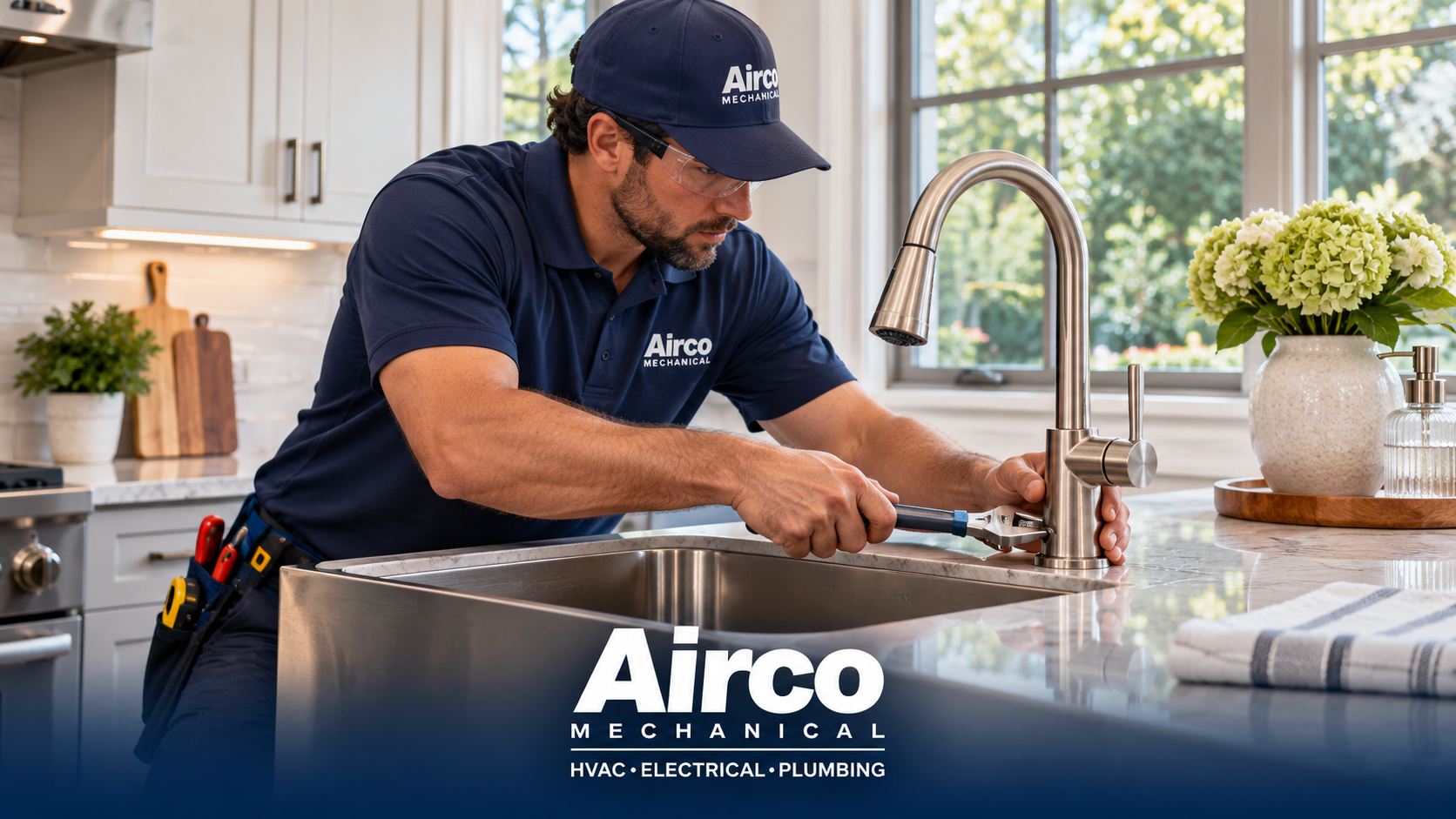
Airco Mechanical provides kitchen plumbing installation and remodeling services for homeowners replacing fixtures or updating kitchen plumbing systems.
Having the existing plumbing reviewed before purchasing fixtures can help homeowners avoid ordering products that require unexpected modifications.
Common Mistakes When Buying Kitchen Sinks and Faucets
Some purchasing decisions appear simple until installation begins.
One common mistake is selecting a sink based only on its outside dimensions without checking the minimum cabinet width or countertop opening.
Another is purchasing an undermount sink without confirming that the countertop material and support method are suitable.
Faucet compatibility is another concern. A homeowner may purchase a faucet with a mounting arrangement that does not match the existing sink.
Other problems can arise when a deep sink interferes with existing drain piping, a faucet lacks sufficient backsplash clearance, or a new garbage disposal does not fit beneath the cabinet.
The most reliable approach is to verify product specifications and existing plumbing conditions before purchasing.
How to Maintain a New Kitchen Sink and Faucet
After installation, basic maintenance can help preserve the appearance and performance of new kitchen fixtures.
Homeowners should clean sinks with products recommended for the selected material. Harsh or abrasive cleaners can damage certain finishes.
Faucet aerators and spray heads may accumulate mineral deposits, particularly in areas with hard water. Cleaning these components according to the manufacturer’s instructions can help maintain water flow.
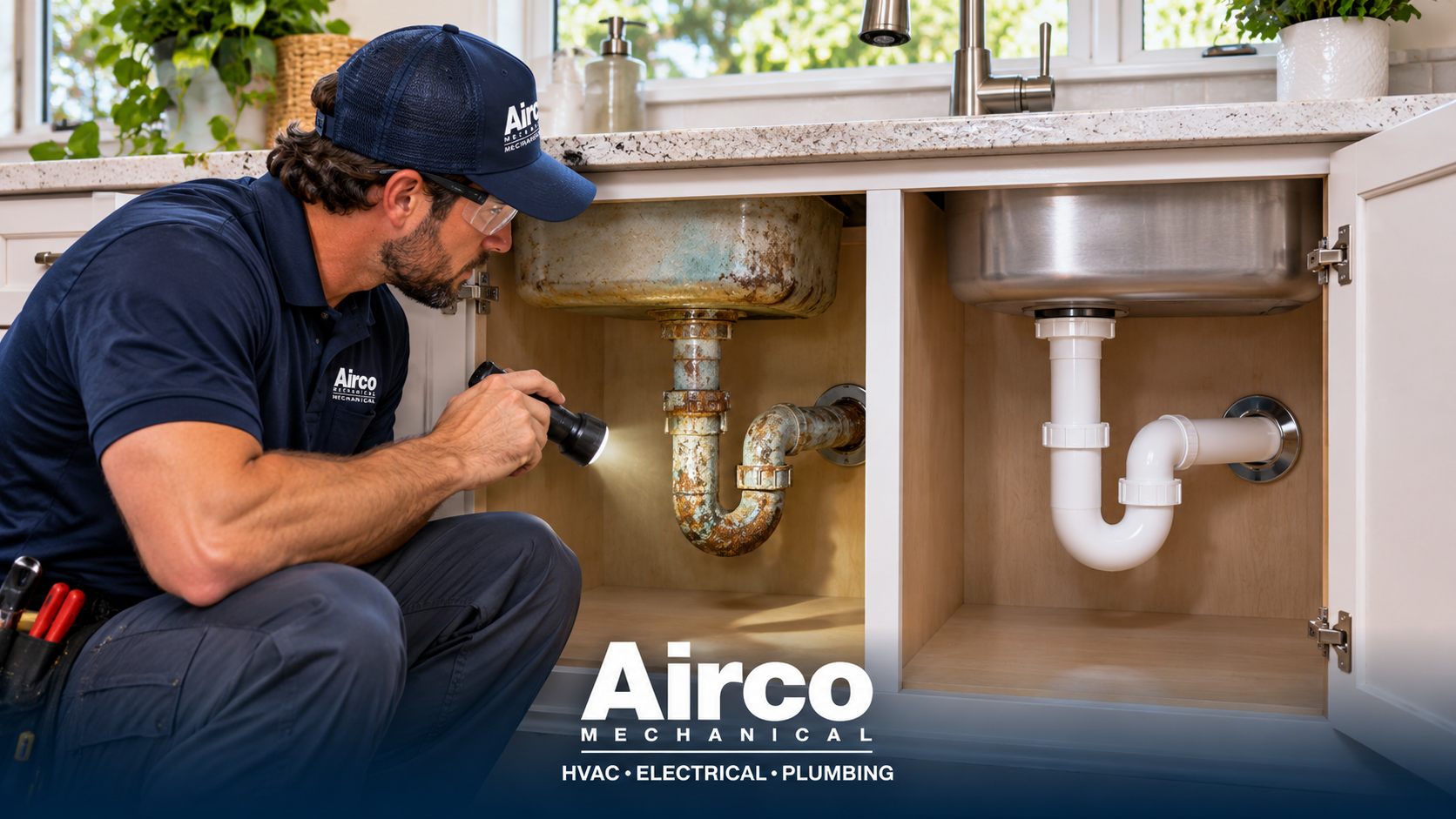
The cabinet beneath the sink should also be inspected periodically for moisture, loose connections, or dripping supply lines.
Kitchen Sink and Faucet Maintenance Checklist
| Maintenance Area | What to Check |
|---|---|
| Faucet | Leaks, handle operation, water flow |
| Spray head | Proper retraction and spray pattern |
| Sink surface | Stains, finish damage, mineral deposits |
| Drain connection | Slow drainage or moisture |
| Supply valves | Visible leaks and accessibility |
| Garbage disposal | Unusual noise, leaks, or drainage problems |
| Under-sink cabinet | Dampness, water stains, or damaged materials |
If a faucet continues leaking after basic maintenance or the drain repeatedly clogs, professional plumbing service may be needed.
When Should You Replace an Existing Kitchen Sink or Faucet?
Replacement may be appropriate when the existing fixture is damaged, difficult to repair, or no longer meets the household’s needs.
A faucet with repeated internal leaks, extensive corrosion, or unavailable replacement parts may be more economical to replace than repair again.
A sink with structural cracks, serious finish damage, or an unsuitable size may also justify replacement.
Homeowners may also choose to upgrade fixtures when remodeling the kitchen, improving accessibility, or changing how the space is used.
However, a working sink or faucet does not need to be replaced simply because it is old.
A professional plumber can help determine whether repair or replacement offers better value.
Why Choose Airco Mechanical for Kitchen Plumbing Installation?
Choosing a kitchen sink and faucet is only part of a successful upgrade. Proper installation helps protect cabinets, countertops, and surrounding materials from leaks and water damage.
Airco Mechanical provides residential kitchen plumbing installation, replacement, repairs, and maintenance for homeowners in Austin and Round Rock, Texas.
Its plumbing professionals can help evaluate existing connections, discuss fixture options, and handle the plumbing work required for a kitchen update.
Whether you are replacing an outdated faucet, installing a new sink, connecting kitchen appliances, or preparing for a complete remodel, professional plumbing support can make the installation process more straightforward.
Conclusion
Choosing the right kitchen sink and faucet requires balancing appearance, functionality, durability, water efficiency, installation compatibility, and long-term maintenance.
Before purchasing, homeowners should measure their cabinets and countertop openings, compare sink materials, review faucet features, and confirm that the selected fixtures work with existing plumbing connections.
A thoughtful buying decision can reduce installation complications, simplify future maintenance, and help create a kitchen that works better for everyday activities.
If you are planning a kitchen plumbing upgrade, contact Airco Mechanical for professional sink installation, faucet replacement, plumbing repairs, and remodeling support in Austin and Round Rock. Call (512) 537-1234 to discuss your kitchen plumbing needs and schedule service.
Frequently Asked Questions
What is the best type of kitchen sink for everyday use?
Stainless steel and granite composite sinks are common choices. The best option depends on cleaning preferences, durability requirements, kitchen design, and budget.
Should I choose a single-bowl or double-bowl kitchen sink?
A single-bowl sink provides more uninterrupted washing space, while a double-bowl sink allows separate washing and rinsing areas.
What should I check before buying a kitchen faucet?
Check mounting holes, faucet height, spout reach, water flow rate, finish, installation requirements, and replacement-part availability.
Can I replace a kitchen sink without changing the plumbing?
Often, yes, if the new sink fits the existing opening and its drain connections are compatible. Different sink sizes or depths may require plumbing adjustments.
Should a professional plumber install a kitchen sink and faucet?
Professional installation is recommended when plumbing modifications, countertop changes, garbage disposal connections, damaged valves, or uncertain installation conditions are involved.