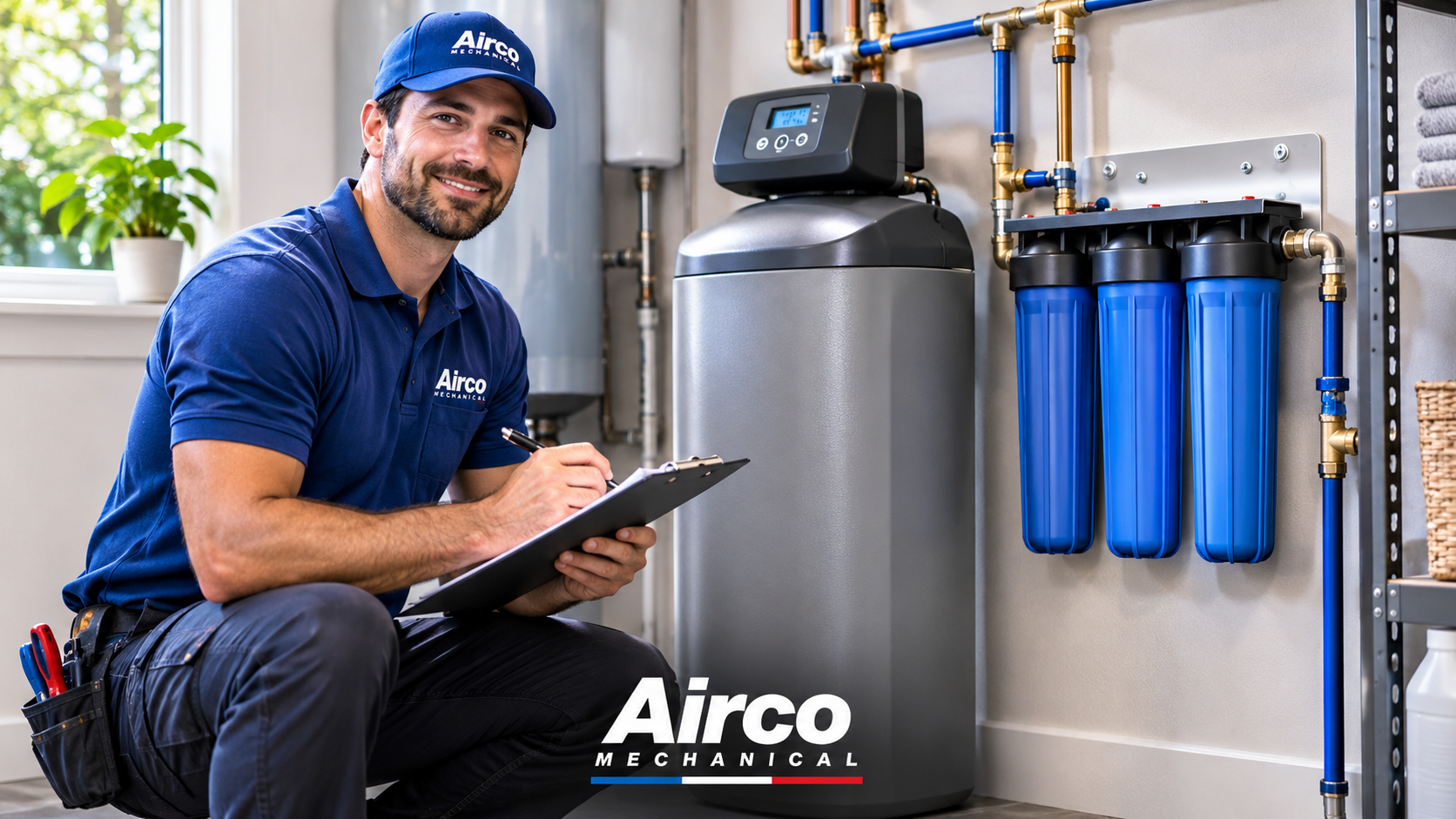
Choosing between a water softener vs. water filter depends on the type of water problem you want to solve. A water softener reduces the calcium and magnesium minerals responsible for hard water, while a water filter is designed to reduce specific substances such as sediment, chlorine, unpleasant tastes, odors, or certain contaminants. Neither system performs every water treatment function. Homeowners should understand their water quality, household needs, and installation requirements before purchasing either option. Professional general plumbing services can help evaluate existing plumbing connections and determine which water treatment setup is appropriate.
Water quality affects everyday activities, including drinking, cooking, bathing, cleaning, and operating household appliances. Mineral deposits can accumulate around faucets and showerheads, while taste or odor concerns may lead homeowners to consider filtration. Airco Mechanical provides residential plumbing installation, replacement, repairs, and maintenance services in Austin, Round Rock, and surrounding Central Texas communities, including support for water filtration systems and water softeners.
Understanding the differences between these systems helps homeowners choose equipment based on their actual needs rather than purchasing unnecessary products.
What Is the Difference Between a Water Softener and a Water Filter?
The main difference is the type of water treatment each system provides.
A water softener targets hardness minerals, primarily calcium and magnesium. These minerals occur naturally in water and can contribute to scale deposits inside water heaters, fixtures, and certain appliances.
A water filter uses a treatment medium or process designed to reduce particular substances in the water. Depending on the technology, a filter may improve taste, reduce sediment, or address specific contaminants.
For example, activated carbon filtration is commonly used to improve chlorine-related taste and odor. Other filtration technologies may be certified to reduce lead or additional substances.
A water softener is therefore not a direct substitute for a drinking water filter, and a typical carbon filter is not a replacement for a dedicated hardness-removal system.
Water Softener vs. Water Filter Comparison
| Feature | Water Softener | Water Filter |
|---|---|---|
| Primary purpose | Reduces water hardness | Reduces specific impurities or contaminants |
| Main concern addressed | Calcium and magnesium minerals | Taste, odor, sediment, or targeted contaminants |
| Common installation | Whole-home water supply | Under-sink, faucet, refrigerator, or whole-home |
| Scale prevention | Can reduce mineral scale formation | Depends on treatment technology |
| Drinking water treatment | Not designed to remove most contaminants | Depends on certification and filter type |
| Maintenance | Salt, regeneration, and system servicing | Cartridge, membrane, or media replacement |
| Operating requirements | Some systems use salt and additional water | Depends on filter technology |
| Best application | Homes with a demonstrated hardness problem | Homes requiring targeted water treatment |
The right choice depends on which issue the homeowner wants to address.
How Does a Water Softener Work?
A traditional water softener uses ion exchange to reduce water hardness.
As incoming water passes through a resin bed, calcium and magnesium ions are exchanged for sodium or potassium ions.
This process reduces the hardness minerals responsible for many scale-related plumbing problems.
Over time, the resin’s capacity to exchange minerals becomes depleted. The system then performs a regeneration cycle to restore its treatment ability.
Many conventional water softeners use salt during regeneration, and the process also consumes water.
The frequency of regeneration depends on the equipment, household water consumption, and incoming water hardness.
What Problems Can a Water Softener Address?
Hard water can contribute to mineral deposits on plumbing fixtures and inside water-using equipment.
Homeowners may notice white deposits around faucets, buildup on showerheads, spots on dishes, or reduced soap lathering.
In some situations, mineral scale can also affect water heaters and other appliances.
A properly selected water softener can reduce these hardness-related concerns.
However, a water softener should not be expected to remove bacteria, viruses, lead, pesticides, or every other potential drinking water contaminant.
Those concerns require separate evaluation and appropriate treatment.
How Does a Water Filter Work?
Water filtration systems use different treatment technologies depending on the substances they are designed to reduce.
Some systems use activated carbon, which can adsorb certain substances responsible for unpleasant tastes and odors.
Others use physical filtration to capture particles such as sediment.
More specialized systems may use membranes, ion exchange media, or combinations of treatment methods.
The effectiveness of any filter depends on its design, certification, condition, and the specific contaminant being targeted.
A filter marketed for improved taste should not automatically be assumed to remove potentially harmful substances.
Homeowners should review the product’s performance data sheet and verified contaminant-reduction claims before purchasing.
Types of Home Water Filtration Systems
Several filtration options are available for residential use. Each has different installation requirements and maintenance needs.
Activated Carbon Water Filters
Activated carbon filters are commonly used in pitchers, refrigerator filters, under-sink systems, and whole-home installations.
They are often selected to improve chlorine-related taste and odor.
Some carbon filters are also certified to reduce particular contaminants, but performance varies by model.
Homeowners should confirm the exact substances the product is certified to reduce rather than assuming all carbon filters provide the same treatment.
Sediment Water Filters
Sediment filters are designed to capture suspended particles such as sand, rust, and other debris.
These systems may be useful where incoming water contains particles that could affect fixtures, plumbing equipment, or additional treatment components.
Sediment filters do not necessarily remove dissolved hardness minerals or chemical contaminants.
Reverse Osmosis Systems
Reverse osmosis, commonly called RO, uses a semipermeable membrane to separate water from certain dissolved substances.
Depending on the certified model, RO systems can reduce specific dissolved contaminants and minerals.
Residential systems are commonly installed beneath kitchen sinks to treat drinking and cooking water.
However, reverse osmosis systems require maintenance, and conventional models can produce wastewater during treatment.
The total cost should include replacement filters, membrane servicing, and water consumption.
Whole-Home Water Filtration Systems
Whole-home filtration systems treat water as it enters the house.
These systems are also called point-of-entry treatment systems.
They may be designed to reduce sediment, chlorine, or other specific substances before water reaches fixtures throughout the property.
A whole-home filter can be useful when treatment is needed for water used beyond drinking and cooking.
However, whole-home treatment is not automatically necessary for every household.
If the concern involves drinking water at one kitchen faucet, a point-of-use system may be more appropriate and economical.
Which System Is Better for Hard Water?
A water softener is generally the more appropriate option when the primary concern is confirmed water hardness.
Hardness occurs because of dissolved calcium and magnesium minerals.
These minerals can contribute to scale buildup, making certain plumbing fixtures and appliances more difficult to maintain.
A standard activated carbon filter does not remove hardness minerals in the same way as a conventional ion-exchange water softener.
Some specialized filtration technologies can reduce dissolved minerals, but their purpose, capacity, and cost may differ significantly from whole-home softening systems.
Before purchasing a softener, homeowners should confirm whether their water hardness is high enough to justify treatment.
Moderate mineral content does not automatically mean that a household needs a whole-home softening system.
How Hard Is the Water in Austin, Texas?
Water hardness varies by water source, treatment system, and location.
According to the Austin Water 2025 Consumer Confidence Report, the city’s reported total hardness averaged approximately 93 milligrams per liter as calcium carbonate, equivalent to 5.4 grains per gallon.
The reported range was approximately 70 to 126 milligrams per liter, or 4.1 to 7.4 grains per gallon.
These figures indicate that Austin’s municipal water has measurable hardness, but individual household conditions can vary.
Homes supplied by private wells or different water utilities may have substantially different mineral levels.
Homeowners should review the most recent water quality report for their actual provider or arrange testing when they need more specific information.
The presence of some hardness does not automatically justify purchasing a water softener. Equipment selection should consider measured hardness, scale-related problems, household needs, and ongoing resource consumption.
Which System Is Better for Drinking Water?
A properly selected water filter is usually more relevant when the primary goal is reducing a specific drinking water contaminant.
For example, a homeowner concerned about chlorine-related taste may consider a certified carbon filtration system.
A household concerned about lead or another contaminant should look for a product independently certified to reduce that specific substance.
A water softener is primarily designed for hardness reduction and should not be treated as a general drinking water purification system.
The Centers for Disease Control and Prevention recommends testing or reviewing water quality information before choosing treatment because different systems address different contaminants.
The CDC also explains that many ordinary household filters are not designed to remove harmful microorganisms.
Homeowners should not assume clear-looking or pleasant-tasting water is necessarily free of contaminants.
For guidance, review the CDC’s recommendations for choosing home water filters.
Water Softener vs. Water Filter: Which Should You Buy?
The better purchase depends on the problem identified through water quality information, testing, or inspection.
| Your Main Concern | Treatment to Consider |
|---|---|
| Mineral scale around fixtures | Water softener or appropriate scale-control solution |
| Chlorine-related taste or odor | Certified activated carbon filtration |
| Sand or rust particles | Suitable sediment filtration |
| Specific drinking water contaminants | Independently certified filter for those contaminants |
| Whole-home taste or odor concerns | Whole-home filtration, if justified |
| Hardness and drinking water concerns | Separate or combined treatment systems |
| No demonstrated water quality issue | Additional treatment may not be necessary |
This comparison is a starting point rather than a substitute for assessing actual water conditions.
A water treatment system should solve an identified problem, not simply add equipment to the home.
Can You Install a Water Softener and Water Filter Together?
Yes. Some homes benefit from using both a water softener and filtration system.
The systems serve different purposes and may complement each other.
For example, a homeowner may use a water softener to reduce hardness throughout the plumbing system and an under-sink filtration system to address drinking water taste or specific contaminants.
Another property may use a whole-home sediment filter before a water softener to protect downstream equipment.
The appropriate arrangement depends on the water quality, treatment technologies, plumbing layout, and manufacturer requirements.
It is important to confirm the correct installation sequence, bypass connections, drainage requirements, and maintenance access before combining systems.
Professional plumbing installation can help ensure that the components are connected and configured correctly.
Whole-Home Water Filter vs. Under-Sink Filter
One of the most important buying decisions is determining where water treatment is actually needed.
An under-sink filter treats water at a specific point of use, usually the kitchen sink.
A whole-home filter treats water entering the house before it reaches multiple fixtures.
When an Under-Sink Filter Makes Sense
An under-sink system may be appropriate when homeowners primarily want to improve drinking and cooking water.
This approach can reduce the need to treat water used for laundry, bathing, toilet flushing, and other activities.
It may also have lower equipment and installation costs compared with a larger whole-home treatment system.
When Whole-Home Filtration Makes Sense
Whole-home filtration may be appropriate when the water quality concern affects multiple areas of the house.
For example, treatment may be justified when a particular substance needs to be reduced in water used for bathing and other household activities.
However, the system must be selected according to the specific treatment goal.
A whole-home carbon filter should not automatically be considered a replacement for other contaminant-specific treatment technologies.
What About Salt-Free Water Conditioners?
Salt-free water conditioners are often marketed as alternatives to conventional water softeners.
However, these systems do not necessarily remove calcium and magnesium minerals from the water.
Some technologies are designed to reduce scale formation by changing how minerals behave rather than reducing their concentration.
This is different from conventional ion-exchange softening.
Homeowners should understand whether a product actually removes hardness minerals or only claims to reduce scale accumulation.
Performance also varies by technology and water conditions.
Before purchasing a salt-free conditioner, review independent testing information and confirm whether its intended function matches the home’s needs.
Water Softener vs. Water Filter Installation Costs
The cost of buying and installing a water treatment system depends on the technology, capacity, location, plumbing configuration, and additional work required.
A basic faucet or under-sink filter is generally less complex to install than a whole-home water softener.
A whole-home system may require connections near the main water supply, additional valves, drain access, and adequate space for future servicing.
Factors That Affect Installation Cost
| Cost Factor | Water Softener | Water Filter |
|---|---|---|
| Equipment size | Based on hardness and water consumption | Based on flow rate and treatment purpose |
| Plumbing modifications | May require main-line connections | Depends on point-of-use or whole-home installation |
| Drain requirements | Common for regenerating systems | Required for some technologies, such as RO |
| Electrical requirements | Some models need power | Depends on filtration technology |
| Space | May need resin and brine tanks | Varies from compact to large systems |
| Maintenance expenses | Salt, water, servicing | Cartridges, membranes, or media |
| Additional installation work | Bypass valves, drain connections | Dedicated faucet or plumbing modifications |
Homeowners should compare the total installation cost rather than the equipment price alone.
A low-cost filter with frequent cartridge replacement may create ongoing expenses.
Likewise, an oversized water softener can increase purchase costs and unnecessary water or salt consumption.
Professional evaluation can help avoid purchasing equipment that does not match the home’s requirements.
What Should You Look for When Buying a Water Softener?
Water softeners should be sized according to measured hardness and household water consumption.
A larger system is not automatically better.
Equipment that regenerates more often than necessary can waste water and salt.
The U.S. Environmental Protection Agency recommends considering demand-initiated regeneration, which allows a softener to regenerate based on actual water usage or measured treatment demand rather than a fixed schedule.
Buyers should also review whether the model meets NSF/ANSI 44 certification requirements and compare its water and salt efficiency.
For more information, see the EPA’s guidance on water-efficient products.
How to Choose a Certified Water Filter
Water filter certifications help homeowners evaluate product claims.
However, certification to one standard does not mean that a product reduces every possible contaminant.
| Standard | Main Application |
|---|---|
| NSF/ANSI 42 | Aesthetic effects such as chlorine-related taste and odor |
| NSF/ANSI 53 | Reduction of specified contaminants with health effects |
| NSF/ANSI 44 | Residential cation-exchange water softeners |
| NSF/ANSI 58 | Reverse osmosis drinking water treatment systems |
| NSF/ANSI 401 | Reduction of certain emerging contaminants |
Buyers should confirm both the applicable certification and the specific contaminant-reduction claim.
For example, an NSF/ANSI 53-certified filter may be certified for certain contaminants but not necessarily every substance covered by that standard.
The NSF water treatment standards guide explains these certifications and why independent verification matters.
Maintenance Requirements for Water Softeners and Filters
Water treatment systems require ongoing maintenance.
A water softener may need salt replenishment, brine tank inspection, regeneration setting checks, and periodic servicing.
Filtration systems may need replacement cartridges, membranes, or treatment media according to the manufacturer’s schedule.
Neglected maintenance can reduce treatment effectiveness and create additional operating problems.
Maintenance Comparison
| Maintenance Area | Water Softener | Water Filter |
|---|---|---|
| Regular supplies | Salt or potassium chloride for applicable models | Replacement cartridges or media |
| Scheduled service | Regeneration and operating checks | Cartridge or membrane changes |
| Performance monitoring | Hardness testing | Water quality and flow monitoring |
| Common concern | Salt bridging, regeneration problems | Clogged or exhausted filter media |
| Professional inspection | Useful for leaks and system operation | Useful for connections and treatment performance |
Maintenance requirements should be considered before purchasing because they affect the overall cost of ownership.
Homeowners who prefer minimal ongoing work may find some point-of-use filtration systems easier to manage than whole-home equipment.
However, actual maintenance depends on the selected system.
How Water Treatment Affects Plumbing and Appliances
Water quality can influence the condition and maintenance needs of household plumbing equipment.
Hardness minerals may contribute to scale deposits in water heaters, showerheads, faucets, and other water-using appliances.
Reducing hardness can help manage mineral buildup where it is a significant concern.
Filtration may protect certain plumbing components from sediment or address other water quality issues, depending on the technology.
However, neither system can repair corroded pipes, fix leaking valves, or reverse existing mechanical damage.
If a homeowner experiences recurring plumbing leaks, pressure problems, or deteriorating connections, the plumbing system should be inspected separately.
Airco Mechanical provides residential plumbing repairs, replacement, and maintenance services for these types of concerns.
Should You Test Your Water Before Buying Treatment Equipment?
Water testing is one of the most useful parts of the buying process.
Purchasing equipment without identifying the problem can result in unnecessary spending or selecting a system that does not address the actual concern.
Homeowners supplied by municipal water can begin by reviewing their utility’s Consumer Confidence Report.
For homes using private wells, appropriate testing is particularly important because the homeowner is responsible for monitoring the water supply.
The testing should reflect the substances of concern and the type of source water.
For example, a hardness test is useful when evaluating water softeners, while concerns about lead, arsenic, bacteria, or other contaminants require appropriate contaminant-specific tests.
Once the problem is identified, the homeowner can compare certified treatment systems designed for that purpose.
Choosing Airco Mechanical for Water Treatment Installation
Water filtration and softening systems need to be compatible with the home’s existing plumbing.
Installation may require connections to the main supply line, under-sink plumbing, shutoff valves, drainage, and other household systems.
Airco Mechanical provides residential plumbing services that include water filtration systems, water softeners, plumbing installation, replacements, repairs, and maintenance.
Homeowners in Austin, Round Rock, and surrounding Central Texas communities can contact Airco Mechanical to discuss their plumbing setup and water treatment installation requirements.
A professional plumbing assessment can help identify available installation space, evaluate connections, and determine whether additional plumbing work is necessary.
Whether you are considering an under-sink filter or a whole-home treatment system, selecting appropriate equipment and arranging proper installation can help avoid compatibility and maintenance problems.
Conclusion
Choosing between a water softener vs. water filter starts with understanding your home’s actual water quality.
A water softener is designed to reduce calcium and magnesium minerals that cause water hardness. A water filter targets specific substances, such as sediment, chlorine-related taste and odor, or certain contaminants, depending on its technology and certification.
For homeowners mainly concerned about mineral scale, a suitable softening or scale-control system may be worth evaluating. For drinking water concerns, a certified filtration system matched to the identified substances may be more appropriate.
Some homes may benefit from both, while others may not need additional water treatment.
Before buying, review your water quality information, compare product certifications, consider installation requirements, and account for ongoing maintenance costs.
For professional water filtration and softener installation, plumbing repairs, replacements, and maintenance, contact Airco Mechanical. The team can help homeowners in Austin and Round Rock discuss their plumbing needs and available service options.
Call (512) 537-1234 or visit Airco Mechanical to request residential plumbing service.
Frequently Asked Questions
Is a water softener better than a water filter?
A water softener is better suited to reducing hardness minerals, while a filter is used to reduce specific impurities or contaminants. The right choice depends on your water quality and treatment goals.
Does a water filter remove hard water?
Most standard carbon filters do not remove dissolved hardness minerals. Some specialized treatment technologies can reduce minerals, but a conventional ion-exchange softener is designed specifically for hardness reduction.
Can I use a water softener and water filter together?
Yes. The systems can complement each other when properly selected and installed. One may reduce hardness while the other treats drinking water or specific contaminants.
Do water softeners require regular maintenance?
Yes. Conventional softeners may require salt replenishment, regeneration checks, brine tank maintenance, and periodic professional servicing.
Is whole-home water filtration worth buying?
It may be worthwhile when a confirmed water quality concern affects multiple household uses. If treatment is only needed for drinking and cooking, a suitable under-sink filter may be more economical.