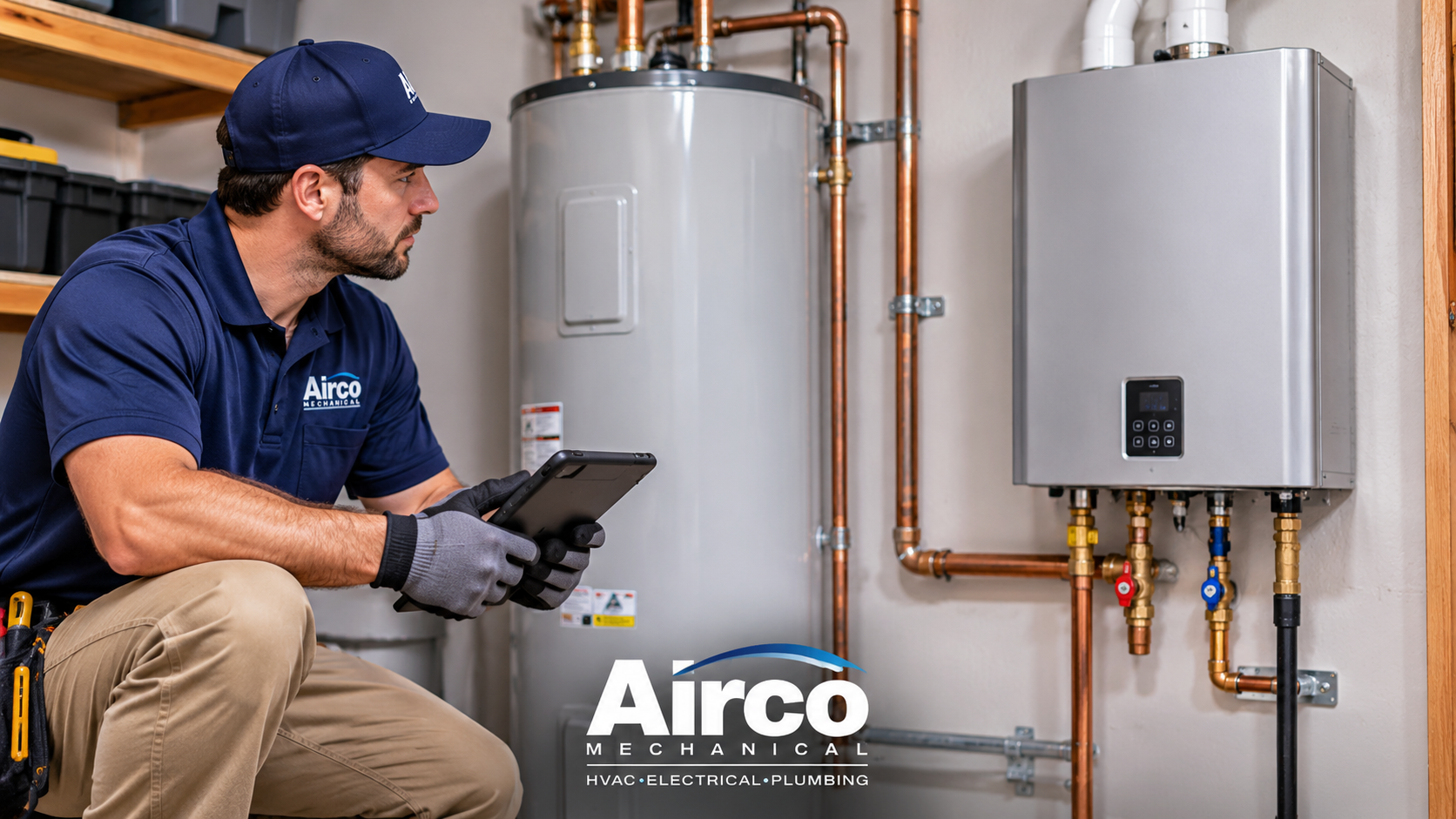
Choosing between a tank vs. tankless water heater depends on your household’s hot water needs, available space, installation budget, energy costs, and long-term maintenance preferences. A traditional tank water heater stores a set amount of heated water for use throughout the day, while a tankless water heater heats water as it flows through the system. Both can provide reliable hot water when properly sized and installed. Homeowners considering a replacement can explore professional general plumbing services to determine which system works best with their existing plumbing and household requirements.
Buying a new water heater is an important investment because it affects everyday activities such as showering, washing dishes, doing laundry, and cleaning. A system that is too small may struggle to meet demand, while equipment that does not suit the home’s infrastructure can increase installation costs. Airco Mechanical provides residential water heater installation, replacement, repairs, and maintenance for homeowners in Austin, Round Rock, and surrounding Central Texas communities.
Understanding how both systems work, what they cost to operate, and how they perform under everyday conditions can help you choose a water heater that delivers reliable service without unnecessary expenses.
What Is a Traditional Tank Water Heater?
A traditional tank water heater, also called a storage water heater, heats water and keeps it inside an insulated storage tank until it is needed.
Residential models are available in different capacities, commonly including 30-, 40-, 50-, and larger-gallon configurations. The appropriate size depends on the home’s hot water demand rather than the number of bathrooms alone.
When someone turns on a hot water faucet, heated water leaves the tank and flows through the home’s plumbing. Cold water enters the tank, and the heating system works to restore the stored water temperature.
Storage water heaters may use electricity, natural gas, or propane, depending on the model.
Advantages of Tank Water Heaters
Traditional tank water heaters are widely used because they are familiar, generally cost less to purchase than comparable tankless systems, and can often replace an existing unit without major plumbing modifications.
They can also deliver a substantial amount of hot water over a short period, provided the tank has enough heated water available.
For homeowners with an existing tank system in good condition, replacing it with a similar properly sized model may be a straightforward installation option.
Limitations of Tank Water Heaters
A tank water heater has a limited amount of stored hot water. When several people use showers, sinks, and appliances close together, the stored supply may become depleted.
The system then needs time to heat incoming cold water.
Traditional tanks also experience standby heat loss because they maintain stored water at a selected temperature, even when nobody is using hot water.
Proper insulation and an efficient model can reduce these losses, but they cannot eliminate them entirely.
What Is a Tankless Water Heater?
A tankless water heater, also known as an on-demand water heater, heats water when a hot water fixture is turned on.
Instead of maintaining a large supply of heated water in a storage tank, it uses a gas burner or electric heating elements to increase the temperature of water moving through the unit.
When the hot water tap closes, heating stops.
Tankless systems are often considered by homeowners who want to reduce standby energy losses, save installation space, or support extended periods of hot water use.
Advantages of Tankless Water Heaters
Tankless systems generally occupy less space than traditional storage tanks and do not need to keep a large volume of water hot throughout the day.
A properly sized unit can support extended showering or other continuous hot water use without exhausting a stored tank.
Gas tankless models may also provide good energy efficiency, particularly in homes where hot water demand is moderate.
However, these benefits depend on the system’s capacity, installation conditions, and actual household usage.
Limitations of Tankless Water Heaters
Tankless water heaters have a maximum flow capacity.
Although they can produce hot water continuously, they cannot necessarily supply unlimited hot water to several fixtures operating at the same time.
For example, using two showers while operating a dishwasher may exceed the capacity of an undersized tankless system.
Tankless installation can also be more complicated when a home needs gas-line modifications, different venting, additional electrical capacity, or other plumbing changes.
Tank vs. Tankless Water Heater Comparison
Both types of water heaters have benefits, but they suit different household requirements.
| Feature | Traditional Tank Water Heater | Tankless Water Heater |
|---|---|---|
| Heating method | Stores heated water | Heats water on demand |
| Hot water supply | Limited by storage and recovery | Continuous within flow capacity |
| Initial purchase cost | Generally lower | Generally higher |
| Installation | Often simpler for a similar replacement | May require infrastructure upgrades |
| Energy use | Includes standby heat loss | Avoids storage tank standby losses |
| Installation space | Requires room for a tank | Typically more compact |
| Multiple simultaneous fixtures | Depends on first-hour delivery | Depends on flow rate and temperature rise |
| Maintenance | Tank flushing and component inspection | Heat exchanger and water-quality-related maintenance |
| Expected service life | Often around 10–15 years | Some models can last 20 years or more |
| Best consideration | Lower initial cost and familiar operation | Space savings and on-demand heating |
These are general differences. Actual performance, cost, and lifespan vary by product type, maintenance, water quality, and installation conditions.
Which Water Heater Is Better for a Family?
Household size is an important consideration, but the number of people living in a home does not tell the whole story.
A family of four that showers at different times may have different hot water needs from a family of four that uses two showers simultaneously while running kitchen appliances.
The key factor is how much hot water the household needs during its busiest periods.
Smaller Households
A smaller household with moderate hot water demand may find a properly sized traditional tank water heater sufficient.
A tankless system may also be attractive if the homeowner wants a compact design and lower standby energy consumption.
The decision often comes down to available budget, existing utility connections, and the home’s future needs.
Larger Families
Larger households may require a water heater with greater delivery capacity.
A traditional storage system can provide a large quantity of heated water during peak demand if its first-hour rating is suitable.
A tankless system can also work well, but it needs enough heating capacity to support the expected flow through multiple fixtures.
Homeowners should avoid assuming that tankless automatically means better performance for larger families.
Homes With Multiple Bathrooms
A home with several bathrooms may experience substantial simultaneous hot water demand.
Before selecting a water heater, consider whether showers, bathtubs, kitchen faucets, and appliances are likely to operate at the same time.
The correct system depends on the combined hot water requirements during those periods.
For some households, a higher-capacity tank system may be appropriate. Others may benefit from a properly sized gas tankless system or a different water heating arrangement.
How to Choose the Right Water Heater Size
Water heater sizing is one of the most important parts of the buying process.
A system that is too small may not provide enough hot water during peak usage. An unnecessarily large system can increase purchase costs and, depending on the design, operating expenses.
Traditional tank and tankless systems are sized differently.
Sizing a Traditional Tank Water Heater
When choosing a storage water heater, homeowners should look beyond the tank’s gallon capacity.
The first-hour rating, commonly called FHR, estimates how much hot water the heater can deliver during one hour when starting with a fully heated tank.
This measurement considers the available stored water and the system’s ability to heat replacement water.
A 50-gallon storage tank, for example, does not necessarily have the same first-hour delivery as another 50-gallon model.
Comparing first-hour ratings can help homeowners choose equipment suited to their expected peak usage.
Sizing a Tankless Water Heater
Tankless water heaters are sized according to flow rate and required temperature rise.
Flow rate is measured in gallons per minute, or GPM.
Temperature rise is the difference between incoming cold water temperature and the desired hot water temperature.
A tankless unit must provide enough heating capacity to meet both requirements.
For example, a home using two showers simultaneously may require more hot water flow than one using a single shower.
Incoming water temperature also affects performance because cooler water requires more energy to reach the selected temperature.
The U.S. Department of Energy’s guidance on transitioning to tankless water heating explains why flow rate, temperature rise, and household demand are essential when selecting equipment.
A professional plumber can evaluate these conditions and recommend appropriate capacity.
Are Tankless Water Heaters More Energy Efficient?
Tankless water heaters can be more energy efficient than conventional storage water heaters because they avoid the standby losses associated with keeping a tank full of hot water.
According to the U.S. Department of Energy, demand-type water heaters can be approximately 24% to 34% more energy efficient than conventional storage tank models in homes using 41 gallons or less of hot water daily.
For households with substantially higher daily usage, around 86 gallons, the reported efficiency advantage can be approximately 8% to 14%.
These estimates describe general comparisons and should not be treated as guaranteed savings for every home.
Actual energy consumption depends on water usage, heater efficiency, fuel type, utility rates, and installation conditions.
Understanding Water Heater Energy Ratings
When comparing water heaters, buyers should review the Uniform Energy Factor, or UEF.
UEF measures the overall efficiency of a water heater under standardized testing conditions. A higher UEF generally indicates better efficiency when comparing models in the same relevant product category and usage pattern.
ENERGY STAR provides efficiency criteria for qualifying gas storage, gas tankless, and heat pump water heaters.
For example, qualifying residential gas tankless models must meet a UEF of at least 0.95 under current ENERGY STAR criteria.
However, homeowners should not compare efficiency ratings without considering fuel type, system capacity, and expected operating costs.
A high-efficiency model may cost more initially, so long-term value depends on the complete purchase and installation price.
Tank vs. Tankless Water Heater Installation Cost
Traditional tank water heaters often have lower initial installation costs, particularly when replacing an existing storage unit with a similar model.
Tankless systems generally require a higher initial investment because of equipment costs and potentially more complex installation requirements.
However, the exact cost depends on the home’s existing plumbing and utility infrastructure.
What Affects Water Heater Installation Costs?
| Installation Factor | Traditional Tank | Tankless |
|---|---|---|
| Equipment purchase | Generally less expensive | Generally more expensive |
| Existing connections | Often reusable for similar replacements | May require changes |
| Gas supply | Depends on model requirements | Higher input demand may require review or upgrade |
| Venting | Depends on fuel and equipment | Model-specific venting may be required |
| Electrical capacity | Depends on heater type | Electric models may need substantial dedicated capacity |
| Space requirements | Requires tank clearance | Compact but still needs service clearance |
| Labor | Often less involved for like-for-like replacement | Can involve additional installation work |
| Permits and inspections | Depend on jurisdiction and scope | Depend on jurisdiction and scope |
Homeowners should request a complete installation estimate before purchasing a water heater.
The lowest-priced unit is not always the least expensive choice once installation modifications are included.
Should You Switch From a Tank to a Tankless Water Heater?
Switching to tankless can be worthwhile, but it is not automatically the right choice for every home.
A homeowner replacing an existing tank water heater should first consider whether the current system meets household demand.
If hot water availability is generally sufficient and the primary issue is an aging storage tank, installing a modern efficient tank may be a practical choice.
If the household frequently experiences exhausted hot water storage, wants to free up space, or is interested in reducing standby energy losses, a tankless system may deserve consideration.
However, homeowners should assess the total conversion cost, especially when plumbing, gas, venting, or electrical upgrades are necessary.
When Keeping a Tank System Makes Sense
A traditional tank water heater may be appropriate when the household wants a lower initial investment and already has suitable space and utility connections.
It can also be a practical choice when the current system’s capacity meets daily needs and the homeowner does not expect major changes in hot water usage.
When Upgrading to Tankless Makes Sense
Tankless may be attractive when space is limited, continuous heating is valuable, and the homeowner plans to remain in the property long enough to benefit from potential operating efficiencies.
It may also be appropriate during remodeling when plumbing and utility changes can be coordinated with other construction work.
The purchase decision should be based on household requirements rather than marketing claims about unlimited hot water or guaranteed savings.
Gas vs. Electric Tankless Water Heaters
Tankless water heaters can use natural gas, propane, or electricity.
Each option has different installation requirements and operating considerations.
Gas tankless models often provide higher hot water delivery rates than smaller electric tankless models, making them suitable for some whole-home applications.
However, they require appropriate gas supply and venting arrangements.
Electric tankless models avoid combustion venting but may need substantial electrical capacity, particularly when serving several fixtures.
For some homes, electrical service limitations can make whole-home electric tankless installation less practical without significant upgrades.
Homeowners should compare the available fuel supply, equipment capacity, energy rates, and installation requirements before selecting a model.
How Long Do Tank and Tankless Water Heaters Last?
Water heater lifespan depends on equipment quality, usage, water conditions, maintenance, and installation.
Traditional tank water heaters commonly last around 10 to 15 years, although some fail sooner and others remain functional longer.
Tankless models may last 20 years or more under suitable conditions, particularly when maintained according to the manufacturer’s recommendations.
These estimates are not guarantees.
Water quality can affect both systems. Mineral buildup, corrosion, temperature settings, and neglected maintenance may shorten equipment life.
Homeowners should consider the age and condition of their current unit when deciding whether replacement is necessary.
Water Heater Maintenance: Tank vs. Tankless
Both traditional and tankless water heaters require maintenance to operate reliably.
Neither system should be considered completely maintenance-free.
Traditional Tank Water Heater Maintenance
Storage water heaters can accumulate sediment at the bottom of the tank.
Sediment may affect heating performance, create unusual sounds, and contribute to long-term equipment problems.
Maintenance may involve inspecting connections, checking for leaks, evaluating safety components, and flushing the tank when appropriate under the manufacturer’s instructions.
The condition of the tank and its corrosion-protection components may also need professional review.
Tankless Water Heater Maintenance
Tankless water heaters can develop mineral deposits inside their heat exchangers.
Scale buildup may restrict flow and reduce heating performance.
Depending on water hardness, usage, and manufacturer requirements, periodic flushing or descaling may be necessary.
A service visit may also include inspecting water filters, combustion components where applicable, venting, connections, and system operation.
| Maintenance Area | Tank Water Heater | Tankless Water Heater |
|---|---|---|
| Mineral buildup | Sediment can accumulate inside tank | Scale can form in heat exchanger |
| Water connections | Inspect for leaks and deterioration | Inspect for leaks and deterioration |
| Routine service | Tank and safety-component checks | Filter, heat exchanger, and operating checks |
| Gas equipment | Venting and combustion safety review | Venting and combustion safety review |
| Hard water | Can increase sediment and scale | Can increase heat exchanger scaling |
| Maintenance frequency | Based on model and water conditions | Based on model and water conditions |
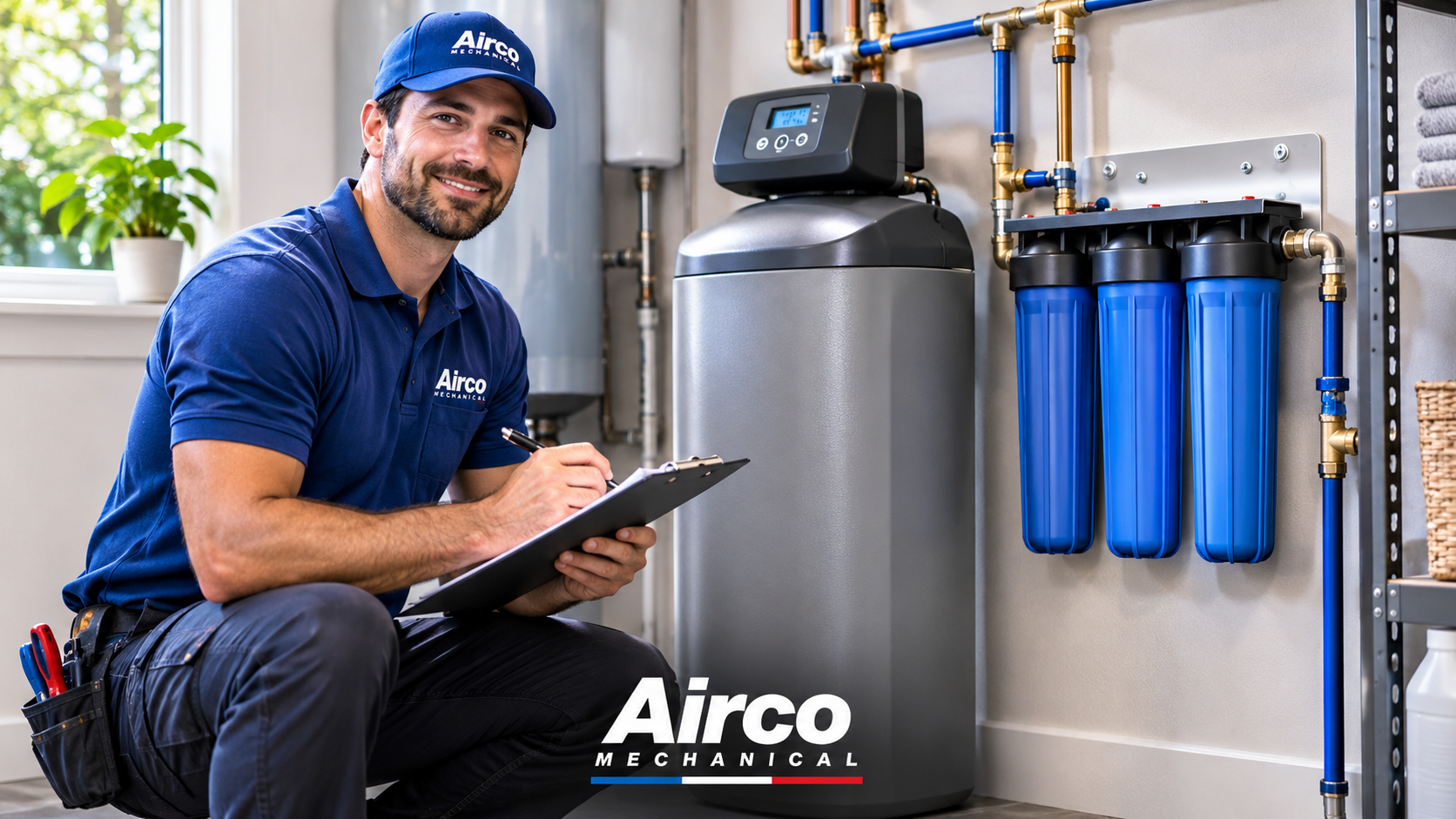
Airco Mechanical provides water heater repairs and maintenance through its residential plumbing services.
Regular professional care can help identify developing issues before they affect hot water availability.
How Hard Water Affects Water Heater Performance
Hard water contains dissolved minerals such as calcium and magnesium.
When water is heated, these minerals can contribute to deposits inside plumbing equipment.
In traditional tanks, mineral accumulation can collect near heating surfaces and the bottom of the tank.
In tankless systems, scale can develop inside narrow heat exchanger passages and affect performance.
The severity depends on local water conditions, operating temperature, and maintenance practices.
Homeowners experiencing repeated scale buildup should consider having their water quality evaluated.
A suitable water treatment system may help manage mineral-related problems, but it should be selected according to the actual water conditions and equipment requirements.
Does a Tankless Water Heater Deliver Hot Water Faster?
Not necessarily.
Tankless water heaters heat water when needed, but that does not mean hot water reaches every faucet immediately.
Water still needs to travel from the heater through the home’s plumbing.
The time required depends on the distance between the water heater and the fixture, pipe layout, and whether a compatible recirculation system is installed.
A bathroom located far from the water heater may still experience a delay before hot water arrives.
Some tankless products support recirculation features, but these systems involve additional equipment and energy considerations.
Homeowners buying a tankless system primarily for faster hot water should discuss this expectation before purchasing.
Are Heat Pump Water Heaters Another Option?
Yes. Homeowners comparing storage and tankless systems should also consider heat pump water heaters when appropriate.
Heat pump water heaters generally use electricity to transfer heat from the surrounding air into stored water rather than generating heat solely through electric resistance.
This can significantly improve energy efficiency compared with conventional electric storage water heaters.
However, installation requires appropriate space, airflow, drainage, electrical connections, and ambient conditions.
A heat pump model may be suitable for some Austin-area homes, particularly when replacing a conventional electric water heater.
The best choice depends on the home’s infrastructure, household demand, and total installation cost.
What Should You Check Before Buying a New Water Heater?
A buying decision should account for both current hot water needs and expected changes over time.
Before purchasing, evaluate household size, simultaneous fixture use, available fuel sources, equipment location, and budget.
It is also important to check product warranties, efficiency ratings, expected maintenance requirements, and installation compatibility.
Water Heater Buying Checklist
| Buying Consideration | What to Review |
|---|---|
| Household demand | Number of users and peak hot water usage |
| Heater capacity | First-hour rating or tankless flow capacity |
| Fuel type | Electricity, natural gas, or propane |
| Energy efficiency | UEF and expected operating expenses |
| Installation space | Equipment size and required clearances |
| Existing connections | Gas, water, electrical, and venting requirements |
| Water quality | Potential mineral buildup and treatment needs |
| Maintenance | Manufacturer-recommended service |
| Warranty | Coverage, exclusions, and service conditions |
| Total cost | Purchase, installation, operation, and maintenance |
A professional assessment can help homeowners avoid buying a water heater that is poorly matched to their home’s requirements.
When Should You Replace Your Existing Water Heater?
A water heater does not necessarily need replacement simply because it has reached a particular age.
However, repeated repairs, declining performance, major component failure, significant corrosion, or leakage from the storage tank can justify replacement.
If the unit is producing less hot water than usual, making unusual sounds, or causing repeated service problems, it should be evaluated.
Some issues can be repaired without replacing the full system.
For example, a faulty heating element, thermostat, or other serviceable component may be replaceable when the heater is otherwise in good condition.
A leaking storage tank, on the other hand, generally requires replacement.
A plumber can determine whether repair is practical or whether a new unit would provide better long-term value.
Why Choose Airco Mechanical for Water Heater Installation?
Choosing the right water heater involves more than comparing product specifications.
The equipment must suit the home’s plumbing layout, hot water demand, available utilities, installation requirements, and maintenance needs.
Airco Mechanical provides residential water heater installation, replacement, repair, and maintenance services for homeowners in Austin, Round Rock, and surrounding Central Texas areas.
The team can help homeowners evaluate traditional and tankless water heating options, discuss equipment requirements, and identify whether an existing unit should be repaired or replaced.
For homes that need additional plumbing modifications, Airco Mechanical also provides residential plumbing installation, pipe repairs, replacement, and maintenance services.
Conclusion
The decision between a tank vs. tankless water heater comes down to your household’s hot water demand, installation budget, available space, energy costs, and long-term priorities.
Traditional tank water heaters remain a practical option for homeowners who want a lower initial investment and reliable hot water storage. Tankless systems can offer space savings and reduced standby energy use, but they need to be correctly sized and may cost more to install.
Neither system is automatically the best choice for every household.
Before purchasing, compare equipment capacity, installation requirements, maintenance needs, and expected operating costs.
If you are planning to replace your water heater, contact Airco Mechanical for professional advice on tank and tankless water heater options, installation, repairs, and maintenance in Austin and Round Rock.
Call (512) 537-1234 or visit Airco Mechanical to schedule residential plumbing service.
Frequently Asked Questions
Is a tankless water heater better than a traditional tank?
Tankless systems can reduce standby energy losses and provide continuous hot water within their rated capacity. Traditional tanks generally cost less to purchase and may be easier to install as a direct replacement.
Is it cheaper to run a tankless water heater?
A tankless model may use less energy than a comparable conventional storage heater, but actual savings depend on fuel costs, household usage, efficiency, and installation conditions.
Can a tankless water heater supply two showers at once?
Yes, if the unit is sized to handle the combined flow rate and required temperature rise. An undersized system may struggle with simultaneous demand.
Do tankless water heaters need maintenance?
Yes. Tankless systems may require periodic descaling, filter cleaning, inspection, and other manufacturer-recommended service, especially where hard water is present.
How do I know what size water heater to buy?
Traditional tank heaters should be evaluated using first-hour rating and household demand. Tankless systems should be selected based on the required gallons per minute and temperature rise.